September 3, 2026 | By Dan Anthon and Joe Scarce
This October, attendees at the 2026 American Art Therapy Association (AATA) Conference in Charlotte, North Carolina, will have a rare opportunity to stand in the presence of history. The Art of the Visionaries of Art Therapy exhibition is returning for its fourth year, bringing with it a powerful, tangible reminder that the very foundation of our profession rests squarely on the backs of artists.
What began as a profound spark of inspiration has steadily gained momentum, traveling to three national conferences and growing each year. On display in Charlotte will be the visual, tangible evidence of a burgeoning field, seen through the art of its founders.
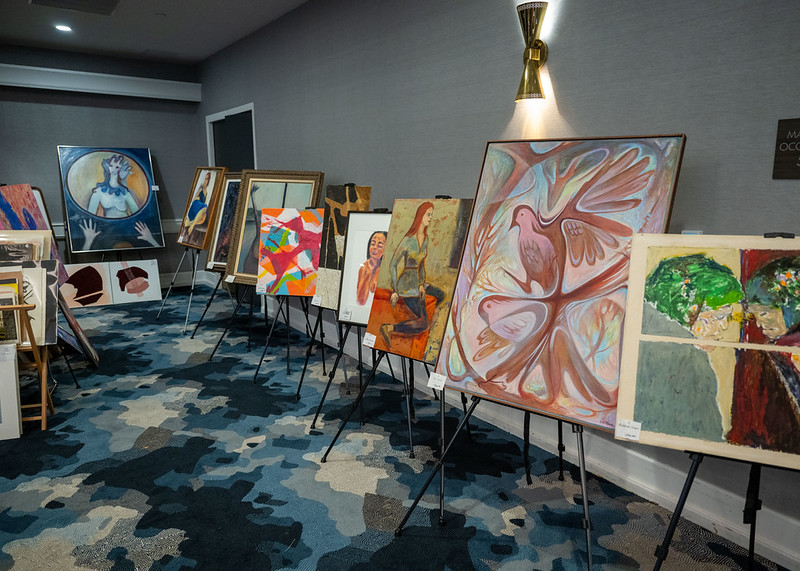
Visitors can stand before a 1947 oil painting of a Rabbi created by Dr. Harriett Wadeson and an array of breathtaking works by Don Jones, Mildred Chapin, Bobbi Stoll, Don Seiden, Vija Lusebrink, and others. Many of these individuals were prolific, exhibiting artists long before they united to build a clinical profession. This exhibit makes one truth absolutely clear: the cornerstone of art therapy was built on the art created by art therapists.
The History: A Silent Wave Over the Table
To truly appreciate the artwork on display in Charlotte, one must understand the deep passion and dedication of the individuals who created it. Decades ago, during the creation of the very first art therapy board certification exam, a consultation team insisted that the draft be reviewed by the founders and living legends of our field. Sitting in that crowded conference room as they entered was a fascinating sociological moment. Among them were the absolute luminaries of our profession—Harriett Wadeson, Myra Levick, Randy Vick, Judy Rubin, Millie Chapin, Shaun McNiff, Don Jones, Bobbi Stoll, Bob Ault, Edith Kramer, and Laurie Wilson, just to name a few.
They represented distinct, fiercely held schools of thought, bringing with them unique perspectives and the inherent tension that comes when deeply passionate pioneers work to define a new field of endeavor. Yet, when Chair Joan Phillips brought the meeting to order, something incredible happened. It was as if a silent wave crashed over the table. In an instant, they set aside their differing viewpoints and placed their shared love for our profession front and center. Fast forward thirty years to Portland, Oregon, in 2025. While the majority of those visionary individuals have now passed on, their families have beautifully bequeathed snapshots of their legacies to us so that this vital history is never lost.
Behind the Exhibit: Honoring the Legacy
The exhibition originally sparked from the mind of Judy Rubin, and the idea of art from the founders as the cornerstone of art therapy truly crystallized when the family of Mildred Lachman-Chapin offered a container of her surviving artwork. Millie was the force behind the inception of the original Art Committee, which established the beloved art studio at our annual conferences. During Judy Rubin’s annual visits to Millie Chapin in Tucson, AZ, Millie often spoke of how she wished that her paintings and drawings would “live with people”.
To bring this vision to life, Judy Rubin and a dedicated committee of art therapists—including Dan Anthon, along with Audrey DiMaria, Zachary Van Den Berg, and Inung Henry Hwang—meet regularly to map out the logistics each year. This collaborative team brings a wealth of unique perspectives and deep professional insights to what is an enormous organizational task. Together with the team at Joe’s Art Time, LLC, (JAT), we manage the massive undertaking of assembling, documenting, and protecting the work of these visionaries.
Original art and high-quality prints will be made available for purchase both at the conference in Charlotte and online. Joe’s Art Time contracts directly with the surviving families, who retain total agency over where the proceeds are directed. While a small percentage is retained by JAT to cover the administrative costs of running the exhibit—including climate-controlled storage, specialized insurance, transport, and promotion—the vast majority of the proceeds are funneled directly back into the profession via student scholarship funds with AATA. As well as special exhibits throughout the year with dedicated proceeds going to non-profits of the visionary family’s choice.
As we look forward to the Charlotte conference, a major initiative is actively underway to further diversify this historic collection. By expanding our reach, we are ensuring the exhibit reflects the full, rich spectrum of diverse voices that have shaped—and continue to shape—the living tapestry of art therapy history.
We hope you’ll join us for AATA2026 in Charlotte, NC, October 14-17, to explore the Art of the Visionaries of Art Therapy exhibition in the Exhibit Hall.