June 17, 2026 | By AATA Board Member Kathryn Snyder, PhD, MA, ATR-BC, LPC
As art therapists, we spend much of our professional lives helping others navigate developmental journeys. We watch children find their voices, adults reimagine their identities, and families build new ways of relating to one another. We spend less time, though, considering how our own professional growth unfolds across a career. This year, I moderated AATA’s 2026 Supervision Series. I attended all three presentations and discussed them with participants and presenters.
Many clinicians think of supervision mainly as a requirement for graduate training or licensure. But contemporary supervision scholarship increasingly frames it as a lifelong developmental process, one that supports not just competence but also professional identity, cultural responsiveness, reflective practice, leadership, and generativity.
Being the moderator for the AATA 2026 three-part Supervision Series offered me a lot to sit with. Across each workshop, I kept returning to one through line: supervision is not a phase we pass through on the way to becoming a clinician. It is a practice that grows with us.
The full 2026 Supervision Series (3 sessions, 6 CE Credits) is now available in AATA’s Online Learning Academy (OLA).
You can register for the full series or a specific session. All AATA CE Sessions are discounted for AATA Members and FREE for AATA Student Members.
About Each Session
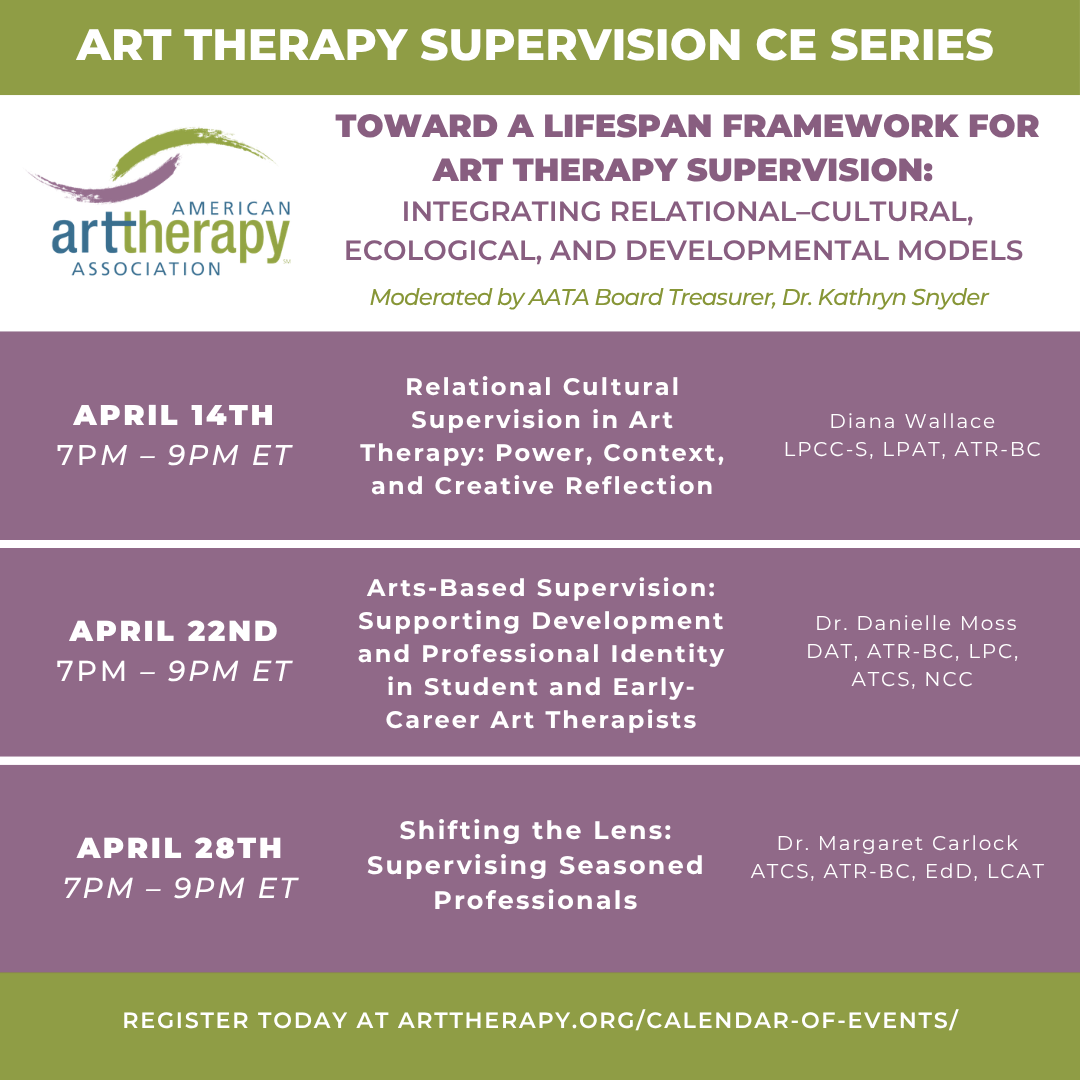
The series began with the broader theoretical foundations of supervision during a presentation led by Dr. Diana Wallace titled Relational Cultural Supervision in Art Therapy: Power, Context, and Creative Reflection. Dr. Diana Waller brought her perspective from her extensive experience as an educator at Ursuline College, clinical supervisor, and scholar to an exploration of developmental supervision, critical pedagogy, multicultural competence, and relational-cultural supervision. Her presentation reminded me that supervision is critically about a growth-fostering relationship that is shaped by culture, context, and power.
Building upon these foundations, in the second presentation Arts-Based Supervision: Supporting Development and Professional Identity in Student and Early-Career Art Therapists Dr. Dani Moss focuses on the developmental experiences of students and early-career art therapists. As Program Director of the ‘Master’s in Art Therapy with a Specialization in Counseling’ at Seton Hill University, Dr. Moss has spent years guiding students through the transition from trainee to professional. Her work highlights the challenges and opportunities of this formative period, when clinicians are learning to balance structure and creativity, integrate clinical knowledge with artistic identity, and develop confidence in their emerging professional voice. Through supervision, students begin the important work of becoming art therapists.
The final session, Shifting the Lens: Supervising Seasoned Professionals, presented by Dr. Margaret Carlock, director at Prescott College’s Expressive Arts Therapy Post Master’s Certificate Program, extends the conversation beyond training and early practice to consider the ongoing developmental needs of experienced clinicians. As art therapists move into roles as supervisors, educators, advocates, and leaders, supervision continues to serve as a space for reflection, renewal, and growth. Dr. Carlock’s perspective emphasizes mentorship, sustainability, and generativity, inviting us to consider how professional wisdom is cultivated and shared across generations of practitioners.
My Reflections
Together, these workshops suggest that supervision extends beyond the educational and pre-licensed timeframe to be a developmental companion throughout a professional arc. Whether we are learning foundational skills, integrating experience into professional identity, or contributing to the growth of others, supervision provides a relational space for continued learning.
Underlying the series is a commitment to relational-cultural and ecological perspectives that recognize professional development as occurring within relationships, communities, institutions, and broader social systems. The series also embraces arts-based approaches to supervision, acknowledging the unique ways that our work as art therapists, through images, symbols, and creative processes, can support reflection and meaning-making across career stages.
As an art therapist, educator, and supervisor, I have become increasingly interested in how supervision helps us navigate the developmental tasks that accompany different phases of professional life. While the questions may change from “Can I do this work?” to “Who am I as a clinician?” to “How do I support the next generation?”, the need for reflection, connection, and growth remains constant.
Perhaps this is what makes supervision so essential to our profession. It reminds us that development does not end with graduation, licensure, or even expertise.
Like the creative process itself, professional growth continues to unfold across a lifetime.