January 25, 2026
We are excited to announce the AATA2026 Call for Proposals and share with you the proposal process.
This year, AATA’s Call for Proposals invites submissions for two event opportunities:
- AATA2026, the in-person conference scheduled for Oct. 14 – 17 in Charlotte, North Carolina
- A two-day live virtual conference, Nov. 14 – 15
Whether you’re considering our In-Person Conference in Charlotte or our Virtual Conference, now’s the time to start brainstorming and drafting your ideas. You don’t have to be an AATA member to apply, but proposals must feature at least one presenter with a master’s degree or higher in art therapy or a related mental health field.
You are welcome to make more than one submission but please note that all presenters will only be selected for up to 3 presentations.
Submissions will be accepted until March 17, 2026, at 11:59 ET.
Need Help Getting Started? These Tools can Help!
- Learn how to craft an ideal proposal in this video from Past-President Nadia Paredes and former Conference Committee Chair Dr. Carolyn Brown Treadon
- Read the Conference Committee’s 9 Tips for Submitting a Successful Proposal.
- Review our 2026 Call for Proposals Guide for details on the submission process, presentation options, and continuing education standards.
Presenting at an AATA conference is an excellent opportunity for you to fine-tune your research, polish your presentation skills, and add to your resume, all while advancing the art therapy profession. Don’t miss out on these opportunities to share your expertise with the art therapy community,
More About AATA2026, the Annual In-Person Conference
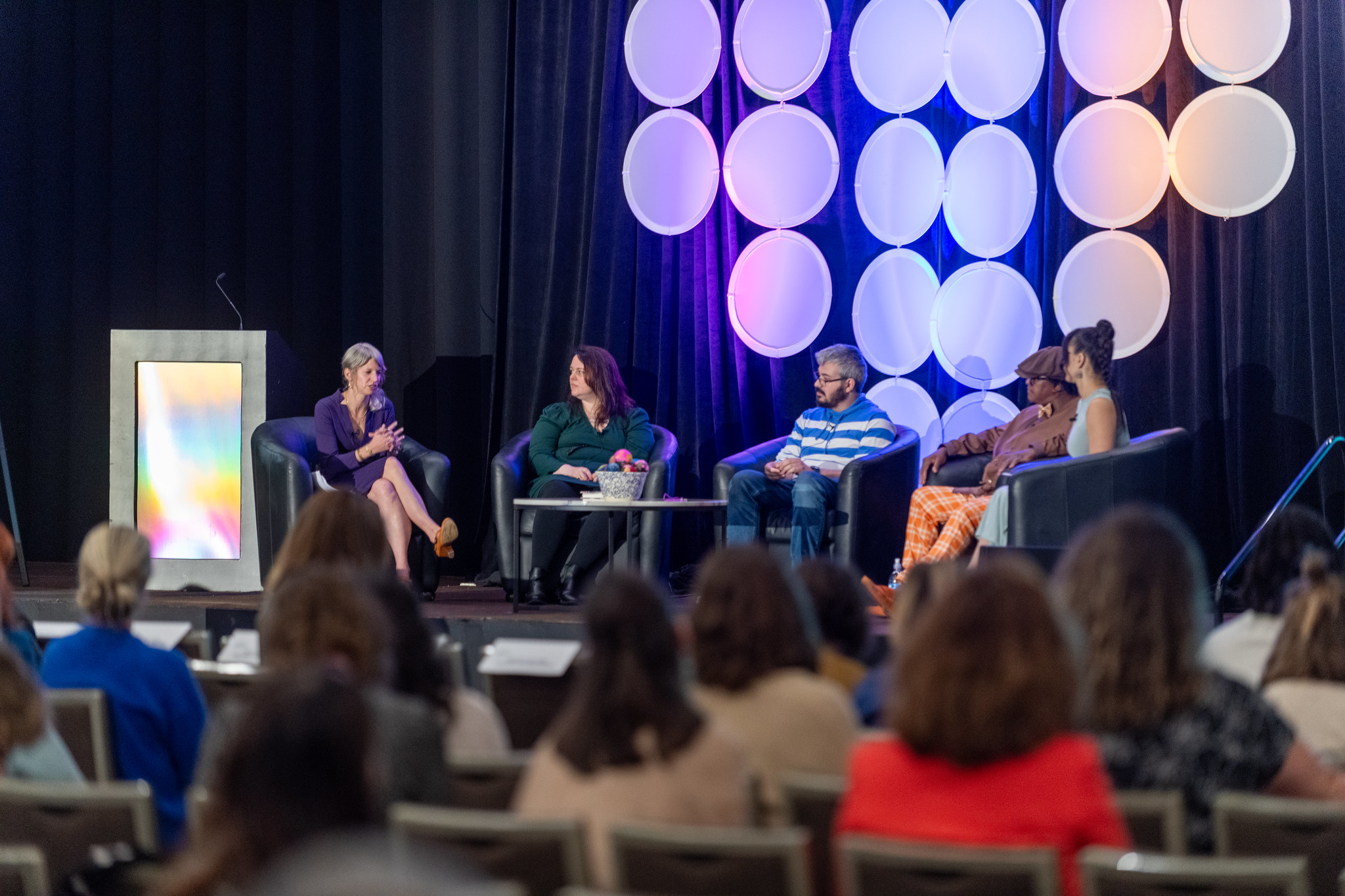
AATA’s 57th Annual Conference will be held October 14 – 17, 2026, at the Le Méridien Charlotte Hotel.
We expect more than 1,000 attendees at this conference, making this conference the largest gathering of art therapists, students, and researchers of the year.
The in-person conference offers presenters a variety of presentation options. Presenters may select from these formats:
Full-Day and Half-Day Advanced Practice Courses: These are three-hour or seven-hour educational sessions with limited seating that aim to teach participants a new technique through experiential learning. Art supplies are provided by AATA.
Workshops: 1.5 hour educational sessions with limited seating and an experiential component to gain hands-on experience and mastery over the material covered. Art supplies are provided by AATA.
Papers: 50-minute lecture-style educational sessions in which up to 3 presenters share information using a slide presentation
Panels: 90-minute conversational or discussion-based presentations led by 3 to 5 presenters
Performance Art: 50-minute educational session in which presenters share information on professional issues or clinical applications in art therapy through performance art modalities, including drama, music, poetry, text, movement, or visual art
Posters: 60-minute sessions in which the presenters share their research on a poster alongside other reseracher’s posters, while attendees walk freely and ask questions. Students and professionals are invited to submit poster proposals.
Video: 50-minute finished video on topics related to professional issues and/or clinical practice.
More About the AATA2026 Virtual Conference
AATA is planning a 2-day Virtual Conference, tentatively scheduled for Saturday, Nov. 14 and Sunday, Nov. 15, 2026. The Virtual Conference will be hosted live on a custom-built virtual conference platform and recorded for viewing in AATA’s Online Learning Academy.
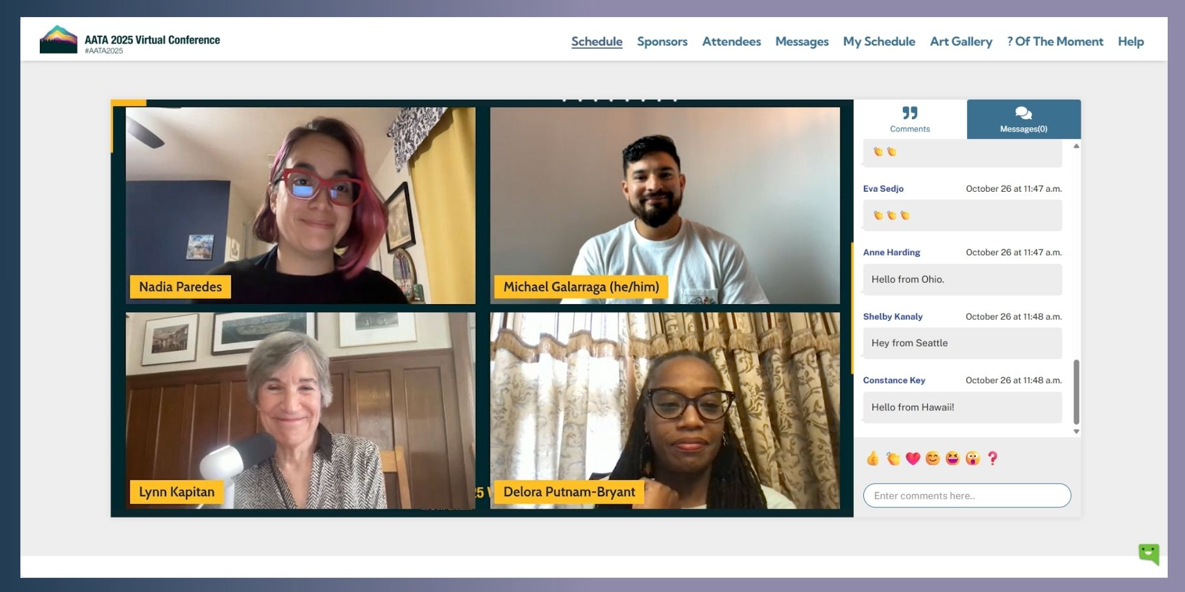
The conference will be comprised of sessions in the following formats:
Panel: A 90-minute educational session featuring 3–5 presenters, including a moderator and a PowerPoint. The panelists engage in an open discussion with one another throughout the presentation to supplement the information included in their slides, with time allocated for audience questions.
Paper: A 50-minute lecture-style presentation featuring up to 3 presenters and a PowerPoint with time allocated for audience questions.
Virtual Workshops: A 90-minute interactive online session led by one or two presenters that combine didactic instruction with guided experiential activities delivered through a virtual platform using screen sharing and live discussion. Workshops are designed to be hands-on and participatory. Participants will be informed in advance of any basic supplies needed for optional off-screen experiential activities.
Spark Sessions: 20-minute fast-paced presentation blocks featuring 3 independent speakers (a combined 60 minutes). These dynamic sessions are designed to be engaging and concise, allowing presenters to share key insights and expertise in a focused format. Spark Sessions are randomly grouped with other sessions within the same track.
Program Tracks for All Submission Opportunities
Both submission opportunities will be organized into nine main subject tracks to help participants find areas of interest. Each proposal submitter must select one subject track to best describe their session
Clinical Approaches
Proposals that present information on therapeutic best practices, case studies, and art therapy techniques and methods, including Addictions/Substance Abuse (AS), Geriatrics (GE) Psychiatric Settings (PS), Child/Adolescents (CA), Medical Settings (MS), School Settings (SS), and Forensics (FS).
Contemporary Issues/Current Trends
Proposals that present information in one of the following areas of interest: Activism (AC), Grief/Mourning (GM), Autism (AU), Professional Practice (PP), Trauma (TR), and Ethics (ET).
Diversity, Equity, and Inclusion (DEI)
Proposals within this category, grounded in the DEI activist movement, explore studies in art therapy assessments, current research, and theoretical models.
Education & Supervision (ES)
Proposals that present information on updates in art therapy training and education and the latest teaching methods. Or focus on supervision techniques and educational developments.
Multicultural Perspectives (MP)
Proposals in this category distinctly highlight the impact of diverse cultural backgrounds on art therapy practices.
Research/Evaluation (RE)
Proposals that present the theory and practice of clinical evaluation, the use of standardized assessments, systematic case studies, outcome studies, and all forms of inquiry, using or exploring various research methodologies.
Studio & Community (SC)
Proposals that present an art studio-based approach and how artist-centered art therapy practice and community outreach programs are designed to improve our collective well-being.
Technology & Innovation (TI)
Proposals that showcase advancements in technology, cutting-edge research, and innovative models in the field of technology.
Theory & Assessment (TA)
Proposals that present studies in art therapy assessments, current research, and theoretical models which should be presented by experienced researchers.