
June 23, 2026 | AATA Board Member Kachina Mooney, MA, LPC, ATR-BC
This piece started as an act of making during a time of political terror. I needed something to do with my hands that was honest. That’s where she came from.
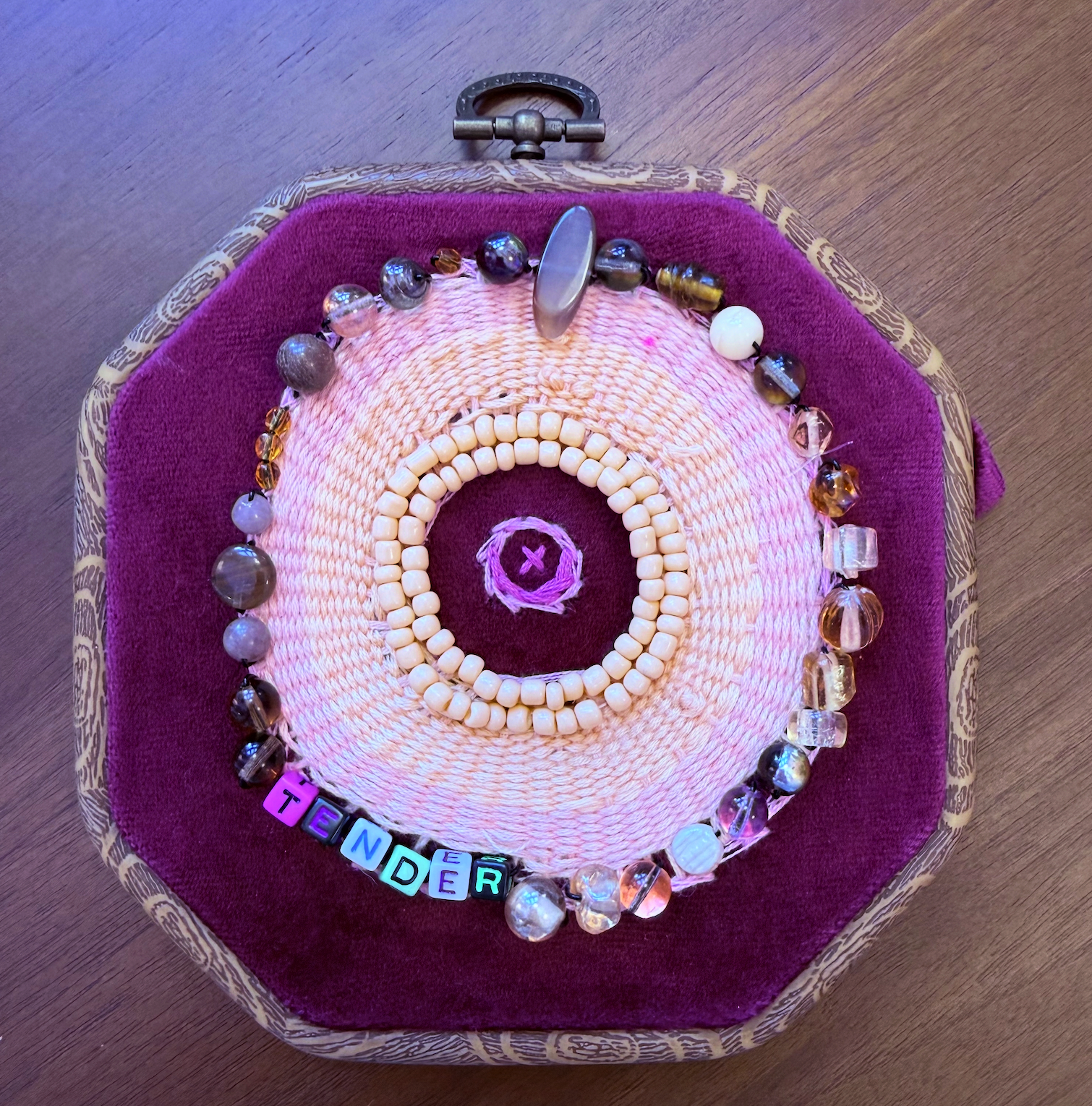
She is coiled, beaded, held in an embroidery hoop: a breast. I named her Tender Tit because I wanted the name to do some work. To be a little irreverent. To insist on softness in a moment when everything keeps asking us to harden. That insistence is political for me. Gentleness is not passivity. It is a practice and something I return to, again and again, in the therapy room, in supervision, in teaching, and now, here, in this hoop frame.
My queerness doesn’t wait outside the clinical door. It comes in with me, held carefully, offered when it’s useful. Present. I think clients deserve to know they are not alone in a neutral room and that they are in a room with someone who has also had to build themselves in a world that didn’t make space for them. That knowing changes something quiet and important.
What I’m witnessing in my clients right now is extraordinary in the truest sense. People are building community with a kind of fierce tenderness: chosen family, mutual aid, rituals made up from scratch because the old ones didn’t fit. These aren’t coping mechanisms; they are forms of life. I try to hold them clinically as exactly that: primary relational resources, not secondary supports.
The weight right now is real, and it is not evenly held. Trans folks. Queer people of color. Elders who recognize this moment in their bodies and who have lived through earlier versions of this fear, who are carrying the recognition of it now. Young people learning to grieve collectively without the maps their elders drew. I do not look away from where the heaviness gathers.
The one thing I’d ask of how we train clinicians is to stop treating affirmation as a destination. Affirmation is a floor, not a ceiling. The real work is attunement and staying genuinely curious about this particular person’s particular beadwork, not assuming you understand the pattern because you learned the vocabulary.
And for anyone making art outside the therapy room as a way of tending to themselves: go toward what draws you. Make imperfect things. Don’t perform healing, simply make what is true. And if the making starts to close you off from people rather than opening you toward them, that’s the signal to let someone else in.
“Tender Tit” reached outward the moment I finished her. That’s what tenderness does.
It doesn’t stay contained.
About Kachina Mooney

Kachina is the founder of Go Glo Therapy, a queer- and trauma-affirming practice that integrates art therapy and talk therapy to support healing, expression, and looking inward. Kachina specializes in trauma-informed care with LGBTQIA+ individuals, immigrants, and clients navigating grief, identity, and life transitions. Her clinical work is informed by her writing and research in art therapy, with a particular focus on queer worldmaking and relational cultural theory.
In addition to her practice, she teaches and mentors emerging art therapists, provides supervision for LPC and ATR candidates, and has served in leadership roles with both the Pennsylvania Art Therapy Association and the American Art Therapy Association. She is deeply committed to inclusive, ethical, and community-centered work within the field.
Kachina currently enjoys living in Pittsburgh with one of her partners and her three elder-cats.
She is also a co-author of Queer Worldmaking in Art Therapy.