
February 1, 2026 | By Megan L. VanMeter, LPC, LMHC, LPC-AT/S, ATR-BC & Lisa D. Hinz, PhD, ATR-BC
This post is the first in a three-part series.
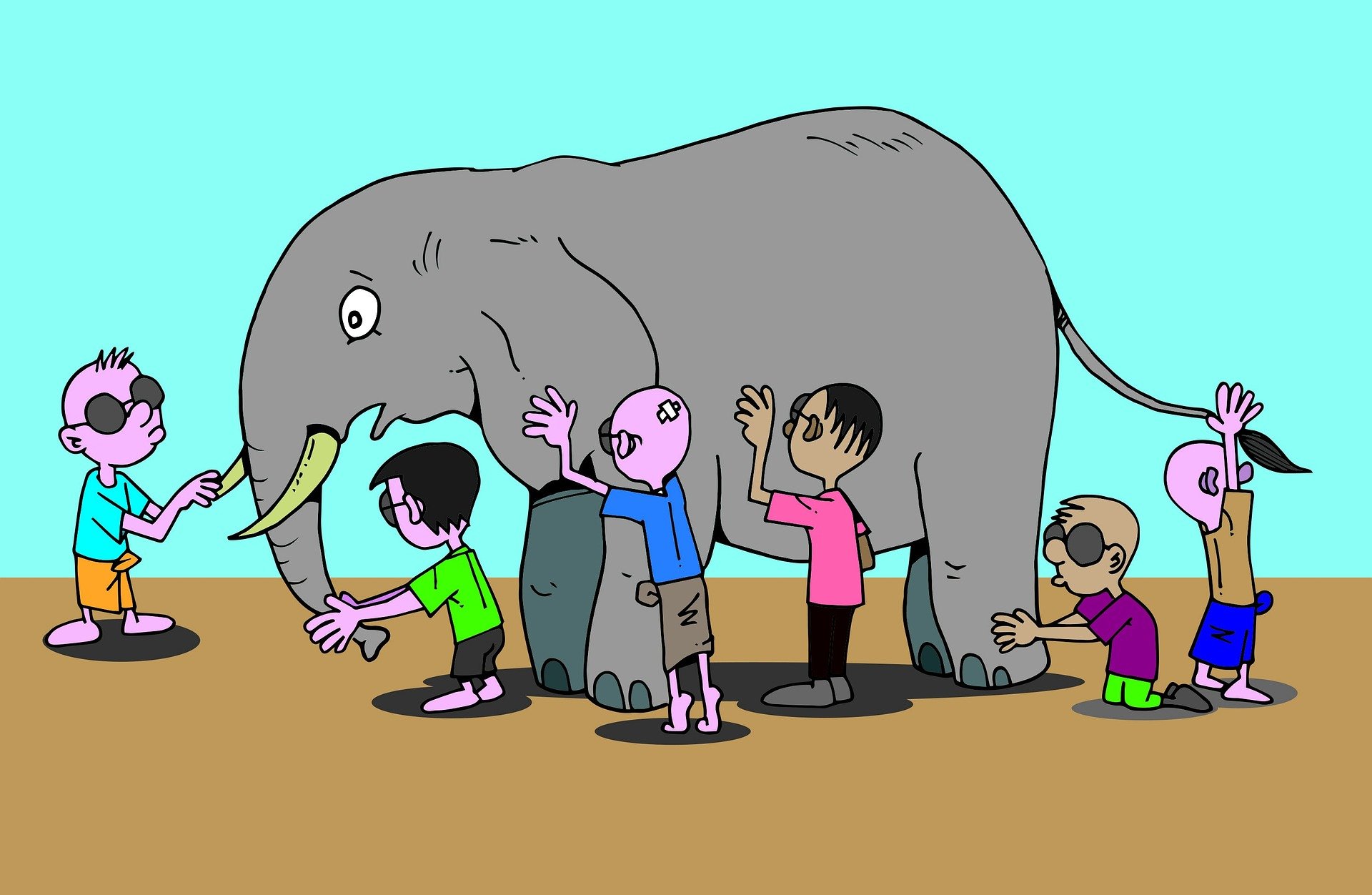
The parable of “Blind Men and the Elephant” is well-known, but what does it have to do with the Expressive Therapies Continuum? The ETC is essentially the elephant in the story. As the parable goes, six visually impaired individuals who don’t know what an elephant is are given the opportunity to touch one and develop familiarity with this large mammal. After the elephant leaves, the men compare notes…and they have a disagreement about what an elephant is. One compares the elephant to a fan, one says an elephant is a pillar or tree trunk, another announces that an elephant is a wall, a fourth man claims the elephant is similar to a rope, a fifth states that an elephant is like a thick snake, and a sixth declares that the elephant is akin to a spear. Who’s right?
The answer depends on each person’s personal experience. The individual who thought the elephant was a fan only encountered its ear. The man who said the elephant was a pillar or tree trunk only encountered its leg. The one who believed the elephant was a wall only encountered its side. The person who claimed the elephant was a rope only encountered its tail. The individual who declared the elephant was a thick snake only encountered its trunk. The man who stated the elephant was a spear only encountered its tusk.
Parables, Myths, and the Expressive Therapies Continuum
“Blind Men and an Elephant” teaches us that we are often oblivious to the possibility of a larger understanding when we form conclusions based on our own limited experiences. This phenomenon tends to be triggered by encounters with something big—elephants in this parable, but broad and deep conceptual frameworks, like the Expressive Therapies Continuum, can also be mistaken for something they’re not if people have had limited encounters with them.
While parables expose aspects of human nature that require self-examination and effortful correction, myths do the opposite; they tell the story of why things are the way they are, and this prevents us from having to look for further data or make changes to the way we think about things (Crossan, 1994). Myths comfort us with their explanations and provide us with a sense of being knowledgeable, even if a myth is untrue.
Unfortunately, myths can stand in the way of progress. The absence of comprehensive formal training in the Expressive Therapies Continuum has spawned many myths about this framework for responsive, outcome-informed, client-centered care. Each myth likely stemmed from someone’s limited encounter with an aspect of the ETC, either through written material or a presentation. Some myths have appeared in published literature and conferences. Before the art therapy profession is caught up in disagreements about the ETC like the people in “Blind Men and an Elephant”, we are providing a “Myths About the Expressive Therapies Continuum” blog series in hopes of helping our peers upgrade their understanding of this framework and learn to spot misinformation about it.
Accurate and Consistent Information About the Expressive Therapies Continuum
The authors here are first-generation ETC students, former pupils of the Expressive Therapies Continuum’s co-creators, Drs. Vija Lusebrink and Sandra (Kagin) Graves-Alcorn. These art therapy pioneers provided us with a mentored training process for learning about the ETC framework and how to operate within it when working with clients. For art therapists who are interested in truly understanding the Expressive Therapies Continuum, retiring the myths they’ve unintentionally been entertaining is an important first step in progressing toward their goals. What about art therapists who don’t necessarily care to know anything beyond the basics of this framework?
Regardless of an individual’s commitment to learning the intricacies and the nuances of the ETC, the whole profession can be made stronger from within if members learn to think about and talk about the ETC with increased accuracy and consistency; inaccurate and inconsistent messaging is confusing to the public and other stakeholders.
Categories of Myths About the Expressive Therapies Continuum
Although many ETC myths are in circulation, we’ve distilled them into three broad categories: myths about the overall framework, myths about the nature of treatment within the framework, and myths about the relationship between art materials and the framework. We’ll talk about the latter two categories in subsequent blog articles, so stay tuned. In the meantime, we would like to address some of the main ETC myths in the first category, myths about the overall framework.
Myths About the Overall Expressive Therapies Continuum Framework
Myth: The ETC is only for art therapists.
Truth: The name of the framework is the Expressive Therapies Continuum, not the Art Therapy Continuum. As such, it was intended by its co-creators to have relevance in the other expressive therapies (Graves-Alcorn & Green, 2014; Hinz, VanMeter, & Lusebrink, 2022). Lusebrink in particular wrote about the ETC’s three levels of information processing as she envisioned them in conjunction with dance/movement therapy, drama therapy, and music therapy (Lusebrink, 1992).
Myth: The ETC explains everything done in the name of art therapy and creativity.
Truth: Although art therapists most certainly relate to the word “creative”, the Creative level (or dimension) of the Expressive Therapies Continuum does not pertain to anything and everything that happens in art therapy. This myth is much like the folktale of ‘The Emperor’s New Clothes”. In this story the emperor believes he is wearing garments of such a fine quality that only the most worthy people can see them. His bubble is burst when someone finally announces what everyone else knows but didn’t want to admit because they thought doing so would advertise their own unworthiness: the emperor wasn’t covered by clothes at all—he was naked.
Similarly, nothing an art therapist does is covered by the ETC unless the art therapist has the training necessary to operate within the framework. Doing so involves the knowledgeable and individualized adjustment of the three Media Dimension Variables (task complexity, task structure, and media properties) on a client-centered basis. This action constitutes deliberate, targeted movement on the Creative level (or dimension) to achieve a horizontal shift within a level or a vertical shift between levels of information processing (Hinz, VanMeter, & Lusebrink, 2022; VanMeter & Hinz, 2024).
Myth: Reaching the Creative level of the ETC is the goal of art therapy.
Truth: This myth appears to stem from a literal interpretation of the ETC schematic drawing, which first appeared in Lusebrink’s 1990 book, Imagery and Visual Expression in Therapy. The drawing depicts the three horizontal levels of information processing with a fourth level that vertically intersects the other levels. This fourth level is the Creative level (or dimension), and the schematic drawing portrays it as extending between the bottom level and top level with some overhang at the top. A literal interpretation of this representation equates the overhang with something “higher” than the top level. As understood in this manner, the Creative level (or dimension) would be thought of as the superior level of the Expressive Therapies Continuum.
However, subsequent versions of the schematic began to include an overhang beneath the bottom level as well. This better represents the Creative level (or dimension), which is not about a kind of information processing like the other three levels are. In 2022, Hinz, Rim, and Lusebrink redesignated the Creative level as a dimension, hoping to further define it as the means by which information processing is shifted. Activation of the Creative level (or dimension) is achieved through the individualized, client-centered adjustment of the three Media Dimension Variables.
This responsive and outcome-informed approach is what facilitates movement within and between the ETC’s three levels of information processing (VanMeter & Hinz, 2024). Reaching the Creative level is not the goal; instead, activating the Creative level (or dimension) occurs throughout the process of ETC-based art therapy to work toward the client’s goal of integrated functioning.
Are You Ready to Learn More About Expressive Therapies Continuum Myths?
Accuracy and uniformity are important assets when members of a profession write about and give presentations about its collective knowledge base. We hope the idea of eradicating myths about the Expressive Therapies Continuum will provide you with the motivation to reexamine your own beliefs about the framework.
Watch for the other two blog articles in this series, and if you are inspired to learn even more about ETC myths and their effect on the profession, please join us for a two-hour webinar on Thursday, February 19, 2026, at 7:00pm ET/4:00pm PT. “Separating Expressive Therapies Continuum Truth from Myth: Guidance for Art Therapy Practitioners, Educators, and Researchers” will be sure to elevate your understanding of the framework and gently correct some of the erroneous stories and tall tales that have been spun about it.
References
Blind men and an elephant (2026, January 19). In Wikipedia.
Crossan, J. D. (1994). The dark interval: Towards a theology of story. Polebridge Press.
Graves-Alcorn, S. L., & Green, E. J. (2014). The Expressive Arts Therapy Continuum: History and theory. In E. Green & Drewes, A (Eds.), Integrating expressive arts and play therapy with children and adolescents (pp. 1-16). Wiley.
Hinz, L. D. (2020). Expressive Therapies Continuum: A framework for using art in therapy (2nd ed.). Routledge. https://doi.org/10.4324/9780429299339
Hinz, L. D., Rim, S., & Lusebrink, V. B. (2022). Clarifying the creative level of the Expressive Therapies Continuum: A different dimension. The Arts in Psychotherapy, 78. https://doi.org/10.1016/j.aip.2022.101896
Hinz, L. D., VanMeter, M. L., & Lusebrink, V. B. (2022). Development of the Expressive Therapies Continuum: The lifework of Vija B. Lusebrink, PhD, ATR-BC, HLM. Art Therapy: Journal of the American Art Therapy Association, 39(4), 219-222. https://doi.org/10.1080/07421656.2022.2131951
Lusebrink, V. B. (1990). Imagery and visual expression in therapy. Plenum Press.
https://doi.org/10.1007/978-1-4757-0444-0
Lusebrink, V. B. (1992). A systems oriented approach to the expressive therapies: The Expressive Therapies Continuum. The Arts in Psychotherapy, 18(5), 395-403. https://doi.org/10.1016/0197-4556(91)90051-B
The emperor’s new clothes (2026, January 19). In Wikipedia.
VanMeter, M. L., & Hinz, L. D. (2024). A deeper dive into the Expressive Therapies Continuum; Structure, function, and the creative dimension. Art Therapy: Journal of the American Art Therapy Association, 41(2), 107-110. https://doi.org/10.1080/07421656.2023.2240682
Vector blind men & elephant with turquoise background by MoteOo (downloaded 01/23/26):
https://pixabay.com/illustrations/blind-men-burmese-elephant-story-1421406/