November 11, 2026
Every November 11, the United States honors those who have served in the military. Veterans Day began as “Armistice Day” in 1919 and became a national holiday in 1938, and today it pays tribute to all American veterans who served honorably in war or peacetime. This Veterans Day, AATA highlights how art therapy, and federal programs like the National Endowment for the Arts’ Creative Forces initiative, support the mental health of service members, veterans, and their families.
Art therapists work with veterans and service members, addressing their unique mental health challenges, including Post Traumatic Stress Disorder (PTSD), combat-related trauma, suicidality, or transitioning into civilian life. Research shows that art-making helps improve overall mental health and offers a nonverbal form of communication when words are inadequate in the face of trauma and similar experiences.
8 Facts to Know about Art Therapy and Veterans
1. Service members have used art to heal for more than 100 years.
Therapeutic art interventions were used during World War I by occupational therapists, Red Cross volunteers and artists, some of whom created wearable masks for disfigured soldiers. Adrian Hill was a British soldier, artist, and author, who first coined the term “art therapy” in 1942. Hill recognized the power of art-making itself as healing while working with soldiers recovering from tuberculosis during World War I.
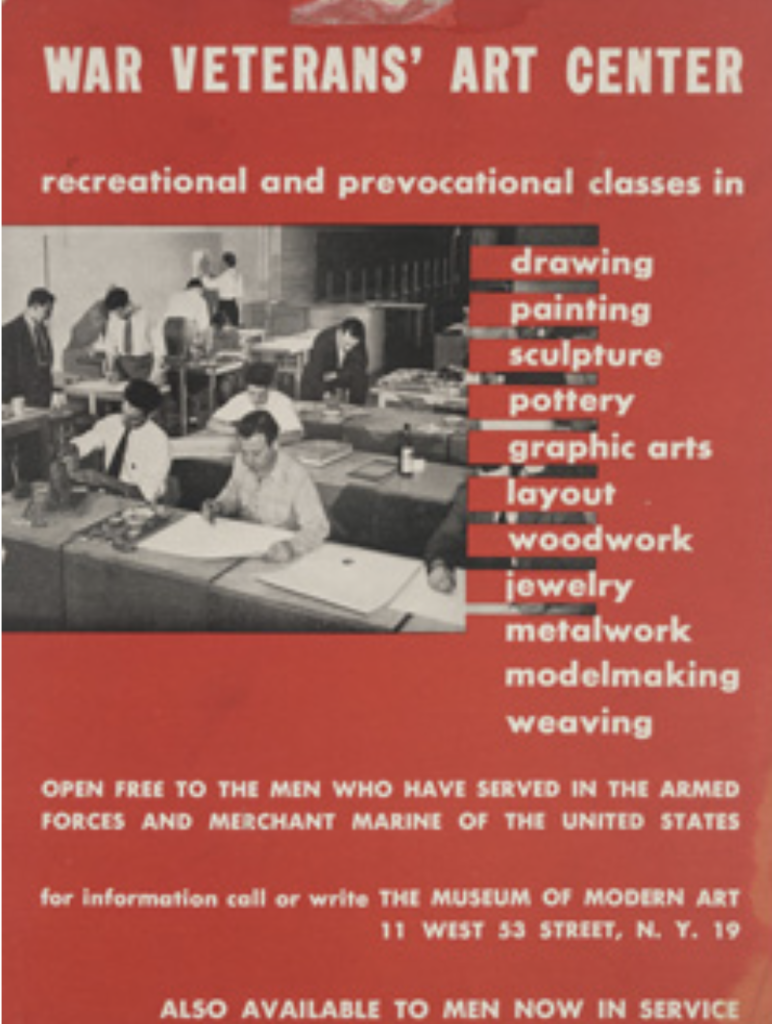
From 1944 – 48, the Museum of Modern Art (MOMA) hosted the War Veterans’ Art Center and used therapists trained in the visual arts to help with rehabilitation. “The principle object of the Center” which served 1,485 post World War II veterans, “was to help veterans adjust themselves through the creative process,” according to a 1948 MOMA press release. (The poster for the Center, c. 1941–45. Source: MOMA).
2. Art Therapy is particularly helpful for veterans.
For returning service members and veterans suffering from PTSD for example, art therapy is used to reduce debilitating symptoms, provide opportunities for expression and resolution of painful memories, and enhance stress reduction through art-based relaxation techniques and coping skills. In fact, a 2018 study found that art therapy experiences fostered improvement in interpersonal relatedness, hopefulness and gratification for the service members in treatment, and helped them construct a trauma narrative imperative for recovery.
“Visual arts offer veterans suffering from PTSD a nonthreatening alternative to compose in images what is inexpressible to them with words,” described Rosemarie Rogers, ATR-BC, LCAT. “It is a way in and often the first step to organize and express overwhelming feelings and sensations they experience. Most importantly, their own artwork becomes the narrative to tell their story and is the foundation that we use to begin therapy.”
3. Longer art therapy treatment leads to better outcomes for service members.
A Creative Forces-supported evaluation compared short and long art therapy programs for active duty service members. Longer-term art therapy produced better perceived outcomes than a three-week program, and service members became more aware of their symptoms and better able to communicate with others. Art therapy also related to improved symptoms for service members with more time in service.
4. Mask-making is a core art therapy tool for service members.
“A mask-making exercise is typically done as one of the first exercises in the art therapy program at the National Intrepid Center of Excellence (NICoE) at Walter Reed,” explained retired Marine Master Gunnery Sergeant Chris Stowe in testimony before a congressional committee on how art therapy helped address his combat injuries.
Research supports what clinicians see in the room. A study published in BMJ Open, funded through Creative Forces, analyzed the masks that 370 active duty service members made at the start of a four-week creative arts therapy program at NICoE. The lead researcher said the team was surprised by how strongly references to belonging tracked with positive health outcomes (Drexel).
“I can attest to the mixed emotions that can be felt during a mask-making exercise: guilt, fear, and self-loathing/self-doubt at first, then, while moving through the making of the mask, feelings of exhilaration, freedom, resolution, and accomplishment can start to emerge. I know that it helped show the way for me as it pertained to how I personally viewed myself. (‘Normal’ on the outside, demon and broken on the inside.)”
– Retired Marine Master Gunnery Sergeant Chris Stowe
5. Veterans who have served after Sept. 11, 2001 are particularly vulnerable to mental health conditions.
According to a 2019 RAND Corporation research brief, roughly one in five veterans experiences mental health conditions, including PTSD, major depression, and anxiety, with veterans who served after September 11, 2001, described as especially vulnerable. The VA’s 2026 National Veteran Suicide Prevention Annual Report found that 6,488 veterans died by suicide in 2024—an average of 17.7 per day, down from 18.2 in 2023. Among those who died, 62% had not received VA health care in the year of their death or the previous year.
6. Supporting federal funding for the arts supports veterans.
The federally funded National Endowment for the Arts’ Creative Forces program offers a national network of care for active duty service members, veterans, and their families and caregivers, in medical treatment or transitioning back home to their bases and communities. In addition, it provides community-based arts opportunities for military and veteran populations and their families around clinical site locations, as well as via virtual arts engagement. Community projects receive $50,000 grants. Visit the Creative Forces National Resource Center to find tools for service members, veterans, their families, and caregivers through the arts.
In August 2026, the NEA and Mid-America Arts Alliance announced grants totaling $888,413 to 48 organizations, with individual awards ranging from $4,669 to $25,000, to support community-based arts projects for military-connected people. These projects provide nonclinical arts programming that addresses the experiences, challenges, and strengths of service members, veterans, and their families and caregivers.
7. There’s a Veterans Crisis Line: 988 then Press 1.
The Veterans Crisis Line’s new number—988 then Press 1—helps make it easier to remember and share the number to access help in times of need. Veterans may also reach the Veterans Crisis Line by text (838255), and through chat (VeteransCrisisLine.net/Chat).
Signed into law in 2020, the National Suicide Hotline Designation Act authorized 988 as the new three-digit number for the National Suicide Prevention Lifeline. The number was activated in July 2022 by all telephone service providers across the US.
You can share these downloadable resources with your networks or on social media to help raise awareness about the 988 number.
8. Veterans are also artists.
While we think of veterans’ art-making as part of their therapy, many veterans are artists in their own right. The National Veterans Art Museum in Chicago hosts the largest collection dedicated to preservation and exhibition of art created by US veterans.
Women veterans, the fastest growing veteran population, are also sharing stories of their military experiences and life accomplishments through art. The Women Veterans Art Project (WVAP) works with the VA to host art exhibitions at select VA medical centers nationwide.

“Invisible Wounds” exhibit, Peter J. Buotte, MFA, MPS
Creative arts festivals such as the Austin Veteran Art Festival (AVAfest), also help showcase veterans’ art. In 2020, we spoke with art therapist, sculptor and veteran Peter J. Buotte, MFA, MPS about his AVAfest exhibit, “Invisible Wounds”. In addition, more than 100 Veterans from across the U.S. attended the 2026 National Veterans Creative Arts Competition., each having earned first-place honors in local VA creative arts competitions in visual arts, creative writing, music, dance, drama, and other artistic disciplines.
These exhibits are also effective ways to help veterans explain and connect with the civilian community around them, so be sure to look for local events in your area or online!
Learn More
Learn more about art therapy and veterans in this presentation, Art, Trauma, and Healing: Artist Talks with Peter Buotte and Rachel Mims, hosted by Austin Community College on Oct. 30, 2025. Rachel Mims is an AATA Board Member, credentialed art therapist US Army veteran, and artist. Peter Buotte is an artist, combat veteran, and licensed art therapist with the Creative Forces: NEA Military Healing Arts Network at the Intrepid Spirit Center/ TBI Clinic at Carl R. Darnall Army Medical Center in Fort Cavazos, Texas.