August 5, 2026
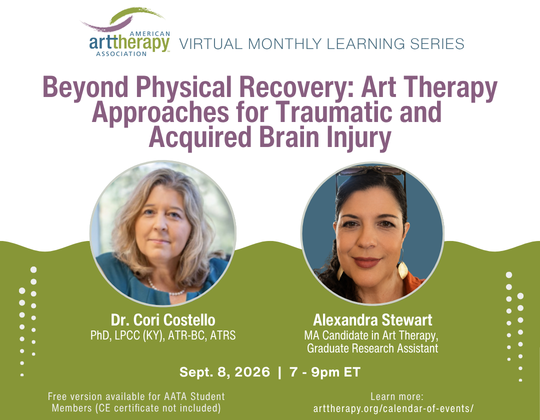
September 8, 2026, 7 – 8 pm ET | 2 CEs | Everyone is Welcome
Register ($52 for Members, $82 for non-members, FREE for all AATA Student Members).
Not an AATA Member? Learn more about Membership
No two brain injuries are alike, and no two recoveries follow the same path. For clinical art therapists working with adults who have acquired a traumatic brain injury, the work demands constant adaptation, shaped by each person’s unique injury, physical recovery, and psychological journey.
In this session, AATA Board Member Dr. Cori Costello and Alexandra Stewart examine how brain injury impacts individuals across the full rehabilitation continuum and explore how art therapy supports emotional adjustment, identity reconstruction, resilience, and renewed participation in life after neurological injury.
Can’t attend live? Register to receive the recording.
About the Session
“The physical body is being challenged every day as part of rehabilitation, and clients also need a safe place to cope with the emotional aspect of recovery, which sometimes takes a back seat; that’s why the expressive art therapy approach is so vital.
Clients can freely express themselves without any repercussions or explanations, and that freedom builds confidence, trust, and renewed autonomy, in addition to finding a creative tool to connect with their body and emotions in a creative way.”
– Alexandra Stewart, Co-Presenter
The work of a clinical art therapist who supports adults with an acquired traumatic brain injury is complex, nuanced, and individualized for each particular injury and is based on long-term physical and psychological factors.
This presentation explores traumatic brain and acquired brain injuries and examines and describes the cognitive, emotional, and psychosocial impact of brain injury across the rehabilitation continuum. The role of art therapy is demonstrated as a therapeutic approach for supporting emotional adjustment, identity reconstruction, resilience, and participation in life following neurological injury. It examines the multiple ethical, legal, and professional considerations in supporting clients in and out of the hospital setting.
Session Tracks: Medical Settings (MS), Professional Practice (PP), Trauma (TR)
Learning Objectives
Participants will be able to:
- Describe the cognitive, emotional, and psychosocial impact of traumatic and acquired brain injury across the rehabilitation continuum.
- Explain the role of art therapy in supporting emotional adjustment, identity reconstruction, resilience, and participation in life following neurological injury.
- Differentiate between directive and non-directive art therapy approaches and select interventions based on cognitive, emotional, and functional needs.
- Apply evidence-informed art therapy techniques and clinical considerations when working with adults recovering from traumatic and acquired brain injury.
Session Format
- 100 minutes of learning content
- 10-20 minutes for Q&A
About the Presenters
Cori Costello
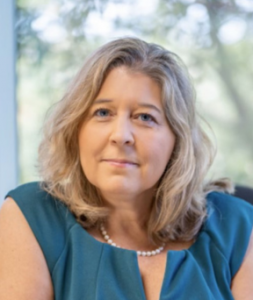
Corinna “Cori” Costello, PhD, LPCC (KY), ATR-BC, ATRS, is an AATA Board Member and has been a licensed counselor and registered/board-certified art therapist for 30 years.
She earned her PhD in Counselor Education and Supervision (2015) and a MAAT from the School of the Art Institute of Chicago (1994). Cori is an Assistant Professor in Art Therapy at the University of Louisville in their art therapy program. Cori’s research includes areas of creativity, mindfulness, brain injury, acquired injury, and recovery and resiliency experiences.
Alexandra Stewart
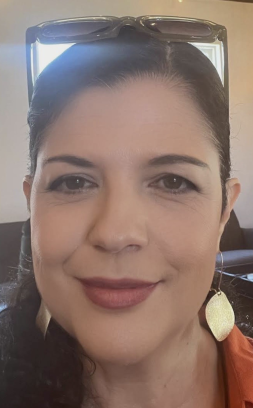
Alexandra Stewart is a Graduate Research Assistant studying Neurorehabilitation and the Arts in Health, and a master’s candidate in Education, with a concentration in Art Therapy.
She spent over ten years in community and nonprofit work, supporting individuals and families affected by trauma, pregnancy and infant loss, and sexual abuse, and creating retreats, workshops, and programs to help people heal and build resilience. Her internship at a long-term neurorehabilitation facility gave her clinical experience providing Art Therapy to adults with TBI, SCI, stroke, and other acquired neurological conditions, as part of a multidisciplinary team.
Alexandra’s clinical and research interests include neurorehabilitation, grief and loss, identity reconstruction, resilience, and participation in life. She uses creative, evidence-based interventions to help individuals adjust emotionally, recover psychosocially, and improve quality of life after neurological injury. She also volunteers with the Brain Injury Alliance of Kentucky, providing therapeutic arts experiences for brain injury survivors and families under Dr. Cori Costello’s supervision.