June 25, 2026
In this thoughtful conversation, Zachary D. Van Den Berg, MA, ATR-BC, LPC (they/he), a queer and genderqueer art therapist, reflects on the studio as a place of witness, queer lineage, imagination, and ethical care. Moving between personal identity, community-making, and the pressures facing LGBTQIA+ people today, Zak considers how art can hold complexity, build connection, and help bring to light more livable futures.
How has your identity shaped your practice, and how do you hold it ethically in the room?
As a queer and genderqueer art therapist, my identity shapes how I understand the relationships among social conditions, mental health, and belonging. Art was one of the first places where I could witness myself when I did not yet have affirming language or representation. Through color, form, and composition, I could give shape to experiences I could not yet name and gradually make a world in which my life, relationships, and future felt more livable. That experience continues to inform my trust in the studio as a place where clients can encounter themselves, experiment with meaning, and create forms of life that feel recognizable and sustaining.
I also bring queer kin and ancestry into the studio. Queer histories, images, and cultural forms can become magnetic frames of reference that make a broader cultural inheritance available. Clients may engage with those references through their own histories and needs. Shared identity can support recognition; but it does not mean shared experience. My queerness also intersects with social positions that confer both privilege and marginalization, so I treat identity as a source of accountability for remaining open, respectful, curious, and responsive to the person sitting with me in the studio, even if we are both queer.
Bringing queer lineage into the studio helps me situate my identity within something larger than my personal story. This allows me to be open while keeping self-disclosure ethical and intentional. My own artmaking, consultation, and relationships of support help me process what belongs to me outside the therapeutic relationship. In this way, I can be genuine and situated while keeping the client’s agency, authority, and autonomy at the center.
What forms of community-making are you witnessing, and why does community matter clinically?
Without speaking for individual clients, I see LGBTQIA+ people building community through chosen family, mutual aid, creative gatherings, digital networks, and collective advocacy. These formations are not simply responses to political threat; they preserve cultural memory, facilitate practical and emotional care, and create spaces where people can be recognized more fully. I am also cautious about framing this work solely as resilience because these networks often become necessary where institutions have excluded, failed, or harmed LGBTQIA+ people.
In my own work, community-making often becomes material. Our Queer Kin brings queer ancestors, elders, and contemporaries across the threshold of the studio, transforming it into a living archive of memory, kinship, and possibility. The Coalition for Queer Creative Arts Therapies builds professional connections and circulates queer-affirming knowledge across geographic distances. Together, these projects make community tangible through images, materials, archives, gatherings, and relationships.
Clinically, community is more than a social support. Supporting clients’ access to what I call critical connections with(in) community can distribute care beyond the therapy dyad. Community may reduce isolation, offer cultural and practical knowledge, provide witness, and make visible futures that are difficult to imagine alone. In this sense, community can alter the relational conditions in which distress is carried and meaning is made.
At the same time, LGBTQIA+ communities are neither singular nor automatically safe. Queer spaces can reproduce racism, transphobia, biphobia, ableism, and class exclusion. The clinical task, therefore, is not simply to direct a client toward “the community.” It is to support their discernment about where they can belong without having to minimize or separate parts of themselves, with safety, consent, and access guiding the process.
What concerns are you hearing, how do they differ, and where does the weight fall most heavily?
In my Austin practice and professional networks, I live, witness, and hear most often the cumulative strain of living under political violence and institutional uncertainty. Clients describe fear, grief, anger, and exhaustion tied to concrete questions: whether health care will remain available, whether schools and workplaces will be safe, and whether institutions will respect their identities, relationships, and families. Some people are responding to harms they have already experienced, while others are living with the anticipation of further loss. Research on structural stigma and anti-LGBTQIA+ policy supports understanding this hostility as a material context for minority-related stress and potentially traumatic experiences. At the same time, I remain careful not to assume what it means for any particular client.
Across age groups, I hear differences shaped by life-course position and lived experience. Some elders and other older adults understand the present through earlier periods of pathologization, discrimination, and institutional exclusion. They may also carry knowledge developed through community organizing, mutual aid, and creative strategies for survival.
Among some millennial clients and colleagues, I hear a sense of reversal: protections that once appeared to be expanding now feel less secure. Many younger people use online spaces for peer connection, identity development, and general support, while adolescents and young adults remain especially affected by decisions made by caregivers and the state.
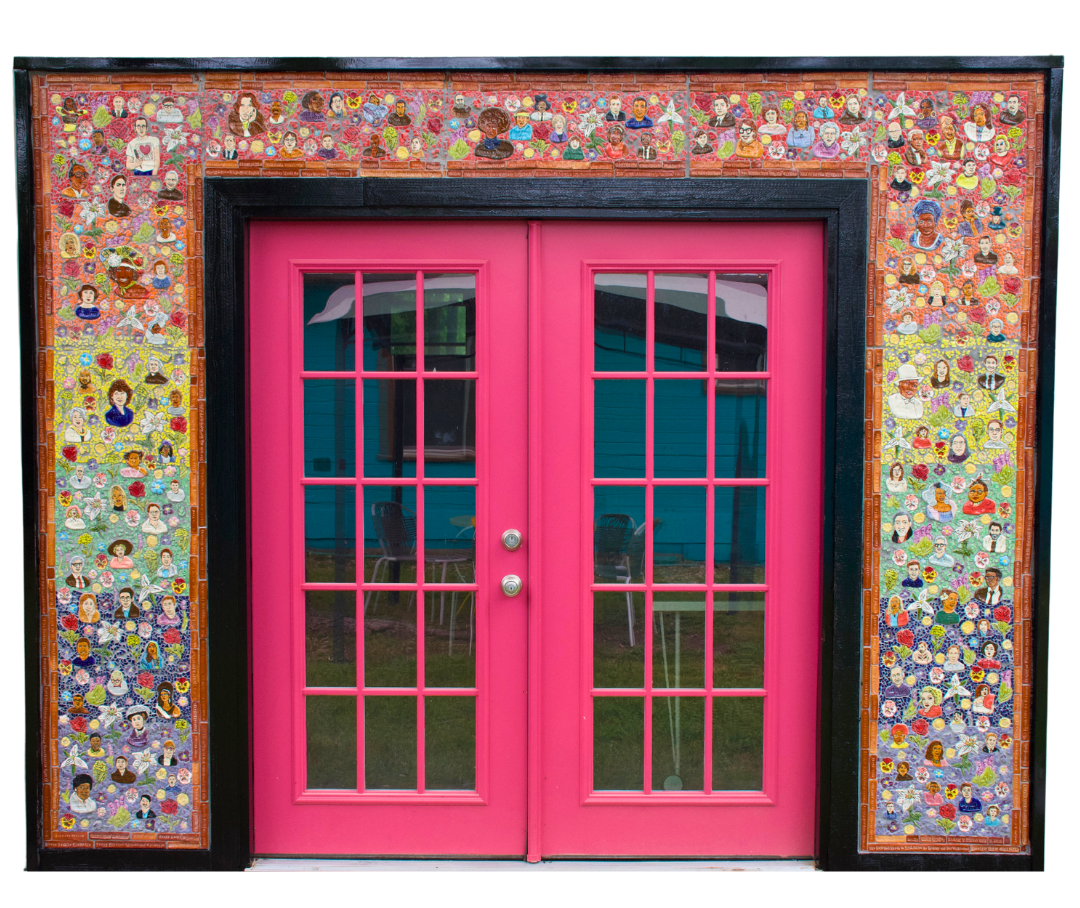
Our Queer Kin, 2024
By Zachary D. Van Den Berg
Porcelain glazed tiles on wedi board
96 x 120 inches
Displayed at Community Arts, LLC Joy Street location in Austin, Texas, USA
Our Queer Kin brings queer ancestors, elders, and contemporaries across the threshold of the studio, transforming it into a living archive of memory, kinship, and possibility.”
In Texas, some of the most explicit current policy restrictions concern trans and gender-diverse people, particularly minors and students, making access to care and support in schools an immediate clinical concern. LGBTQIA+ people of color may encounter racism within LGBTQIA+ spaces and cis-heterosexism in other communities and institutions. Bi+ people may experience identity invalidation or invisibility; for those in mixed-gender relationships, their sexual identity may be less visible to others.
Austin has LGBTQIA+-focused organizations and a municipal advisory commission, but local infrastructure cannot eliminate statewide legal constraints or make affirming care equally accessible. In my context, I see the weight falling most heavily on trans and gender-diverse young people and those without the financial or geographic flexibility to seek care elsewhere.
What should change in professional training and practice?
If I could change one thing, I would move training and supervision beyond a checklist or mastery model of LGBTQIA+ competence toward sustained critical self-reflexivity and studio response-ability. By studio response-ability, I mean the therapist’s capacity to remain attentive and accountable to the client, the artwork, the materials, and the social conditions shaping the work without forcing predetermined meanings or outcomes. This approach preserves clinical responsibility while decentering the therapist as the sole authority over meaning.
Every art therapist is socially situated. Regardless of identity, clinicians bring personal and cultural histories of sex, sexuality, gender, and relationships into the studio. Those histories should be examined through reflexive artmaking, supervision, consultation, and, when appropriate, personal therapy. LGBTQIA+ clinicians are not exempt from internalized cis-heteronormativity. For cisgender heterosexual clinicians, social privilege can make dominant assumptions seem neutral, universal, or simply invisible; deliberate examination is therefore especially important.
Affirming practice also means not assuming that identity is the reason for treatment. LGBTQIA+ clients seek care for a broad range of concerns, and sexuality, gender, or relationships may be central, peripheral, or unrelated to their goals. Clinicians should neither ignore the effects of cis-heterosexism when they are relevant nor presume that sexual or gender diversity is itself the problem to be treated. The client’s language, priorities, and sense of relevance should guide the focus of the work.
In LGBTQIA+-affirming art therapy, we need to examine whether our studios, images, and resources reflect queer and trans bodies, chosen and expansive forms of kinship, LGBTQIA+ histories, intersecting identities, and diverse aesthetic traditions. We also need to notice how our training and personal histories shape what we perceive in clients’ artwork, including assumptions about gender expression, sexuality, bodies, relationships, and family. Reflexive artmaking can help us identify implicit and explicit biases so that they can be examined in supervision or consultation rather than imposed on a client’s image. Art therapists should resist interpretations that treat artwork as evidence of a client’s identity or readiness to disclose; we must preserve the client’s authority in choosing materials, determining meaning, and deciding whether and how their LGBTQIA+ identity enters the therapeutic work.
What well-meaning clinicians most often get wrong is treating inclusive language or respectful intentions as evidence that cis-heterosexist bias is no longer operating. A clinician can use affirming terminology while still steering a client toward normative expectations around disclosure, gender expression, or relationships styles. For me, the central ethical question is whether the studio supports the enabling conditions for the client’s authority in setting goals, engaging materials, making meaning, and choosing how to respond.
How can LGBTQIA+ people use expressive practice outside art therapy?
Self-directed expressive practice may support well-being by helping people give form to experience, reconnect with pleasure, and imagine possibilities that are difficult to reach through words alone. Queer ancestors and cultural forms can offer generous points of departure: a song, video, image, text, performance, or archive may invite a new creative response and connect the maker with queer lives across time. Open-ended making can offer similar possibilities without requiring a predetermined theme, interpretation, or outcome.
When public recognition and respect are withheld, asserting one’s presence through art can itself be radical. Creative practice can make room for the messiness, complexity, beauty, pleasure, fatigue, sadness, rage, and grief of queer life. By giving these feelings material, narrative, or embodied form, art can move them beyond the private register of personal failure and make visible the social and political conditions that shape them.
Creative expression can function as protest, but it does not have to be public or explicitly political to be consequential. Making art and engaging in creative process, alone or alongside others can help someone remain in contact with their depth of feeling and renewed capacity for delight. Pleasure, however brief, can help sustain the aliveness that makes continued resistance and relationship possible. These everyday creative practices belong alongside more visible forms of protest as ways of claiming presence: “We’re here, we’re queer, get used to it.”
About Zachary D. Van Den Berg
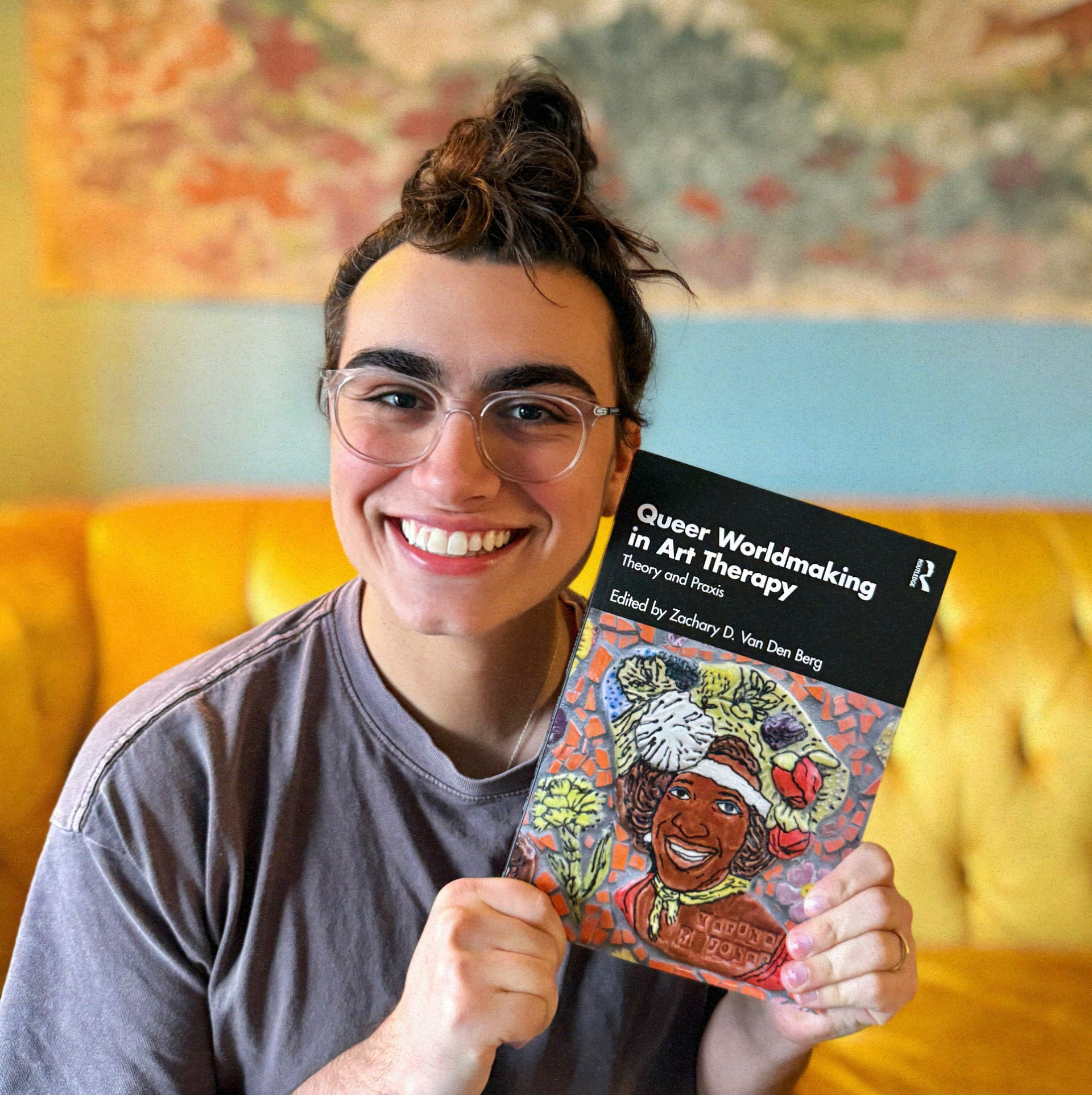
Zachary D. Van Den Berg, MA, LPC, ATR-BC (they/he), is an art therapist, scholar, and founder of the Coalition for Queer Creative Arts Therapies Inc. in Austin, Texas, United States.
Zak is also the editor of Queer Worldmaking in Art Therapy: Theory and Praxis, published in June 2026.
Connect with the Coalition for Queer Creatives Arts Therapies on Instagram.