June 10, 2026
The American Art Therapy Association represents a diversity of professionals, students, and organizations across the nation. We recognize and celebrate the work of our members at all levels through our Featured Member series.
For this profile, we spoke with AATA Member Elizabeth Fotopoulos, PhD, LCPC, ATR-BC, ATCS, a practicing art therapist, counselor, and core faculty member specializing in supervision and ethics.
What advice would you give someone interested in pursuing a career in art therapy?
If you love art and have an interest in helping people, art therapy could be your outlet. It is a profession that offers so much to the individuals and communities it serves, and it is also among the most rewarding for the professional.
I love the energy, excitement, and liberation that art therapy offers. Seeing art therapists in training and my supervisees persevere through difficulties or significant challenges, and finish strong and confident makes the work worth it.
If you were talking to a potential client about why art therapy is unique, what would you say?
If you want to get to the root of the “issue(s)”, make art.
“Art is in everything that we do. It’s in how we decorate our spaces and ourselves. Art has been a part of us since the beginning of humankind. This is what makes art therapy the most effective form of counseling.”
— Dr. Elizabeth Fotopoulos
Art is also the most adaptable; it molds to fit the individualized client, and it can be difficult to hide behind art. Art shows the true self, the core of the issues, which can be elicited sometimes very quickly in a safe manner.
As an art therapist, what excites (or inspires) you most about your job right now?
The eureka effect, “A-ha” moment. This sudden understanding of something that was incomprehensible prior has always been exciting to witness. Seeing a person make connections, heal parts of themselves, and release parts of themselves to enter into peace is what I look forward to every clinical day.
Has working with a particular client group shaped your professional focus or specialty?
All of my clinical work has been rewarding, but nothing has shaped me more than working with clients navigating chronic trauma and gender identity transition. I am deeply grateful to those who have allowed me to witness their journeys toward self-acceptance and liberation. These experiences have expanded my awareness and educated me in ways I continue to carry forward
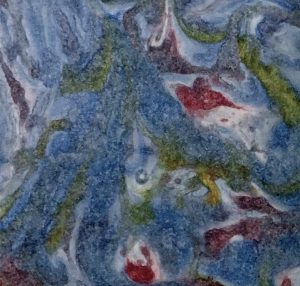
Venice, Italy
By Elizabeth Fotopoulous, 2008
Marbling with Oil Paint
This was a representation of a summer I spent in Venice, Italy. The warmth and juxtaposition of water meets stone, and the winding streets and canals that always seemed to connect back to one another.
What are your hopes for the future of the profession?
Our perspectives and creative brains are needed in so many spaces, that include but are not limited to politics and law. I believe it will take art therapists stepping into these new spaces for the field to cover the ground it still has ahead and to serve in more expansive ways.
I would love to see more art therapists branch out to connect with other counseling disciplines. I believe this cross-collaboration is needed for art therapy to become more widely known, trusted, and respected. This also makes me wish for more art therapists to facilitate research, publish it, and present it at conferences around the world.
About Elizabeth Fotopoulos, PhD, LCPC, ATR-BC, ATCS
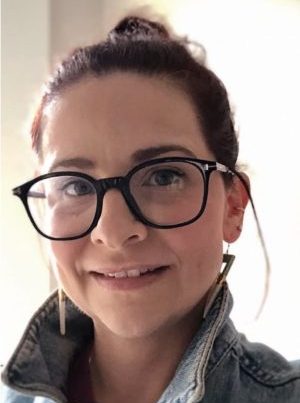
I am a practicing art therapist and counselor since 2012 and have worked in community mental health, crisis counseling with children, acute adult services, and private practice. Upon completing my doctorate in Counselor Education and Supervision, I became core faculty at Adler University, Chicago, and continue to teach within their master’s programs (on the ground and online) and the doctorate in art therapy program. My specialization is supervision and ethics. I supervise people seeking their ATR credential and clinical counseling licensure, and have supervised people nationally and globally.
I have used arts-based supervision practices with both art therapists and non-arts-based counselors, which has been an amazing experience. Because of my interest in ethics, I also have a close connection with the ATCB. I have served as an item writer, content specialist, and most recently held a board of directors position.